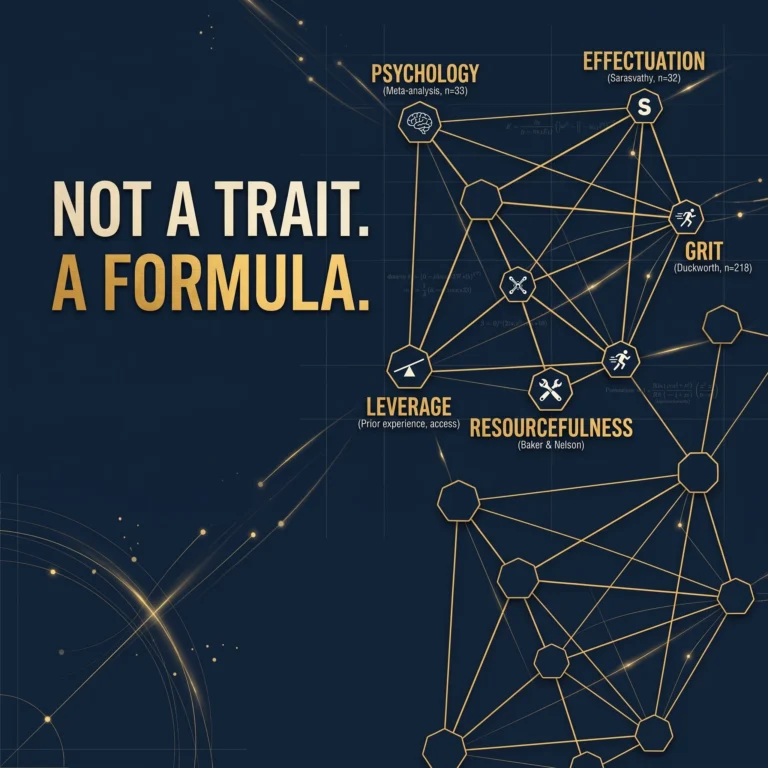
Personality research can describe tendencies. It can't tell you whether you'll build a successful business.
Research has found statistical differences between entrepreneurs and managers on several Big Five personality dimensions, but the individual effects are small. That evidence supports talking about tendencies and associations, not deterministic “types” or predictions of business success. The BizInfo Africa assessment is designed as a short research-mapped reflection tool rather than a test of whether someone will succeed.
Zhao and Seibert's 2006 meta-analysis compared entrepreneurs with managers on the Big Five personality dimensions.[1] It found differences on four of them: entrepreneurs scored higher on Conscientiousness and Openness and lower on Neuroticism and Agreeableness, with no significant difference on Extraversion. The effect sizes for each dimension were small. That supports talking about tendencies and associations with entrepreneurial status, not fixed types.
Why a tendency isn't a prediction
The research doesn't show that a personality profile decides whether someone starts, sustains or scales a business. Outcomes depend on a lot that sits outside personality: opportunity, financing, market structure, skills, networks and execution. Seibert's own framing in the Stanford Social Innovation Review is that traits may raise your odds but don't determine whether you can be an entrepreneur.[2]
The Entrepreneur Type Assessment has ten questions, takes about three minutes and maps your answers to that published framework. Use it for reflection: which of your tendencies help you operate, and which could become blind spots? Short assessments vary in how well they're validated, so treat the result as a prompt for thinking and not as a diagnosis, or a screening tool for hiring, lending or investing.
Then move from the founder to the business. Personality tells you little about cash flow, buyers or paperwork, so test those directly with the Financial Health Check, the Procurement Readiness Checker and the Business Confidence Index. Use a verified evaluation when someone else has to rely on the facts.
Use personality research for reflection. Use business evidence for business decisions.
Request your verified reportExplore the toolsCommon questions
What personality traits are associated with entrepreneurs?
A 2006 meta-analysis found statistically significant differences between entrepreneurs and managers on four Big Five dimensions. The individual effect sizes were small.
Does personality predict entrepreneurial success?
The cited research does not establish that a personality profile determines business success. It supports discussion of associations with entrepreneurial status, not a deterministic prediction.
What does Big Five research say about entrepreneurs?
The meta-analysis reported higher Conscientiousness and Openness and lower Neuroticism and Agreeableness among entrepreneurs relative to managers, with no significant difference on Extraversion.
Is an entrepreneur personality test accurate?
Accuracy depends on what the test is designed to measure and how well it is validated. A short research-mapped assessment should be treated as reflection rather than diagnosis or prediction.
What can a personality assessment actually tell a founder?
It can prompt reflection on tendencies. It cannot by itself establish business capability, market fit, governance quality or likely financial performance.
Sources
Sources and figures checked 2 October 2026. Verification services by ASAP Information Services Ltd.
Could Your Business Survive the Judges’ Questions?