Rethinking Africa’s Risk Premium
For decades, Africa has been labeled “too risky” for serious investment,volatile, fragile, unpredictable.
But what if that perception is based on outdated maps?
At a recent economic forum, Dr. Akinwumi Adesina, President of the African Development Bank (AfDB), presented data that challenges this narrative:
“The rate of loss in Africa is 1.7%. That in Latin America was about 13%.”
(African Development Bank)
This stark contrast suggests that Africa’s actual investment risk is lower than commonly perceived. However, it’s crucial to delve deeper into this data to understand its implications fully.
Perception vs. Reality: A Narrow Gap or a Wide One?
Silas Omenda, founder of Divergent, emphasizes that the issue lies not in the numbers but in the narratives.
“Remove the wars from the equation and what’s left is a robust, underexplored trading ecosystem.”
While the AfDB’s 1.7% loss rate is compelling, it’s based on a specific subset of investments,those with guarantees and policy support. Private capital, especially in SMEs and startups, faces different challenges:(African Development Bank)
- Currency volatility
- Policy inconsistency
- Limited exit options
- Legal enforcement gaps
These factors contribute to higher perceived risks and, consequently, higher capital costs.



Resource Sovereignty ≠ Instability
Recent shifts in West Africa, such as nationalizing resources and asserting economic independence, are often labeled as instability. However, Silas offers a different perspective:
“Don’t call it a coup. Call it an emancipation of trade.”
While these moves may reflect legitimate aspirations for sovereignty, they can spook institutional investors, especially when tied to military regimes or sanction-triggered instability. Honest conversations about Africa’s rebalancing,one where agency, transparency, and accountability are part of the frame,are essential.
Time to Recode the Risk Models
Traditional investment models often rely on:
- Outdated sovereign credit ratings
- Collateral-heavy banking systems
- Undiversified export assumptions
As Silas notes:
“Africa is an SME continent. But most financing still expects land titles and hard assets,when what young entrepreneurs actually hold are digital assets and ideas.”
This misalignment creates artificial barriers to investment. Institutions like the AfDB and regional Development Finance Institutions (DFIs) are beginning to recalibrate, but mainstream capital is still lagging behind.
AfCFTA: A $3.4 Trillion Dream,Still Under Construction
The African Continental Free Trade Area (AfCFTA) is the most ambitious trade integration project in modern history. It promises:
- Zero tariffs across member states
- A unified $3.4 trillion market
- Cross-border value chain formation
However, execution is behind the curve. Silas observes:
“On paper, AfCFTA is brilliant. But paper doesn’t move goods. Infrastructure does.”
The major bottlenecks include logistics gaps, policy misalignment, and payment friction. The African Development Bank and Afreximbank have invested $65 billion in infrastructure since 2020, yet the annual investment gap remains over $100 billion. (Reuters)
Africa’s Youth Dividend Has a Maturity Date
Africa’s demographic advantage,over 60% of the population under 25,is a double-edged sword. Silas warns:(DHL Logistics of Things)
“This is a seasonal advantage. We either harness it,or we lose it.”
Governments from Burkina Faso to Rwanda are building local value chains to retain capital and reinvest in education, healthcare, and infrastructure. However, scaling this requires capital that can flow into unconventional assets, youth-owned startups, and digitally native businesses.
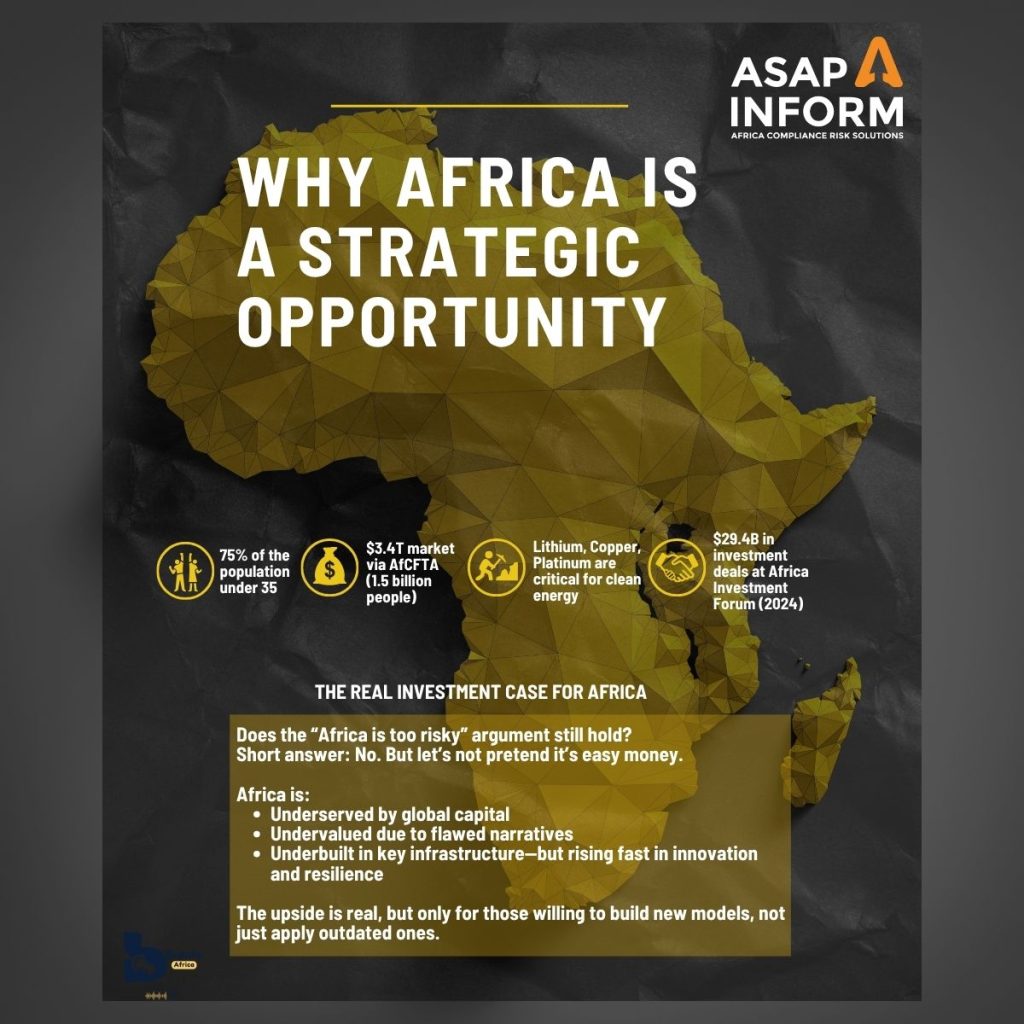
The Real Investment Case for Africa
So, does the “Africa is too risky” argument still hold?
Short answer: No. But let’s not pretend it’s easy money.
Africa is:
- Underserved by global capital
- Undervalued due to flawed narratives
- Underbuilt in key infrastructure,but rising fast in innovation and resilience
The upside is real. But only for those willing to build new models,not just apply old ones.
Africa Isn’t a Bet. It’s a Strategy.
If Africa were a startup, your pitch deck would read:
- Market: $3.4T intra-continental trade potential
- Differentiator: Youth, mobile-first economy, resource revaluation
- Moat: Narrative arbitrage
- Risk: Overstated,and outdated
Update the Model, Reprice the Continent
At BizInfo Africa, we’re committed to spotlighting the people, data, and deals that prove Africa isn’t high-risk,it’s high-potential.
For more stories, reliable SME and on-the-ground insights?
Visit bizinfo-africa.com.
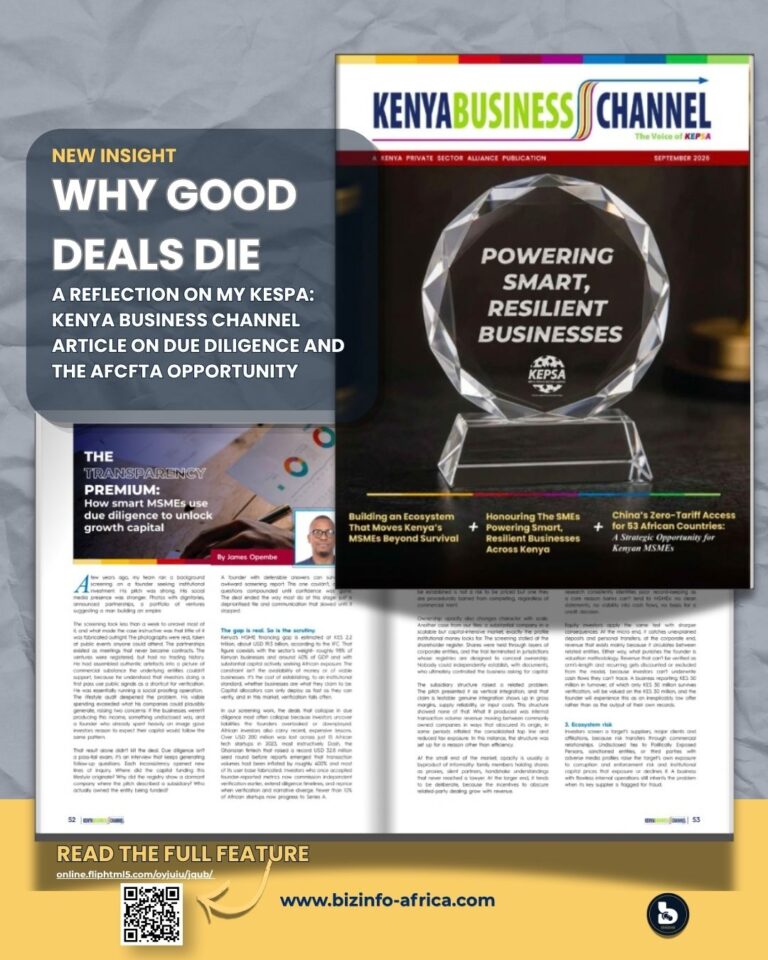
Need credible verification, market entry intelligence, or due diligence in Kenya and across Africa?
Partner with ASAP Information Services: asapinform.com | #ASAP_Inform