
Stop Blaming Red Tape: The Real Reason Africa Is Stifled Is Predictability
You think you know why African economies struggle, right?
Overregulation. Too many rules. Endless permits. That’s the easy, comfortable answer.
But our analysis says you’ve been looking at the wrong variable.
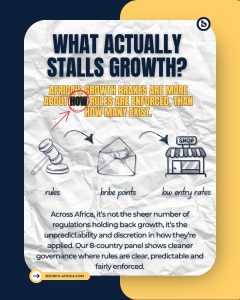
The problem isn’t the quantity of rules. It’s the sheer, unpredictable mess of how they’re enforced. That single distinction is the difference between stalled development and massive wealth creation.
We call it The Enforcement Trap.







The R=0.91 Wake-Up Call
Everywhere you look, officials operating with discretion turn a simple regulation into a high-leverage “bribe point.” The system is not broken by design; it’s sabotaged by inconsistent application.
This is not theory. This is data.
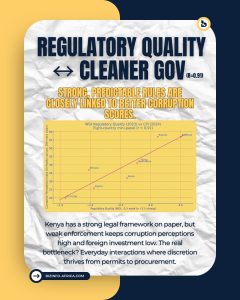
When we charted a country’s Regulatory Quality (WGI RQ) against its Corruption Perception Index (CPI) score, we found a staggering correlation: R=0.91.
The message is deafening: Predictable rules lead directly to clean governance. Where governance is clean, Foreign Direct Investments – FDI flows, businesses scale, and people get rich.
- The Models: Why do Rwanda and Botswana see higher, steadier FDI? Because they combine strong frameworks with non-negotiable, consistent enforcement. The rules work.
- The Warning: Kenya has strong anti-corruption laws on paper. But its enforcement is weak and discretionary, keeping its CPI low (32/100) and its FDI marginal. Strong laws mean nothing when enforcement is a chaotic coin flip.
The Dual Failure: Rules and Services
Fixing the paperwork is a start, but it’s not enough.
South Africa is the starkest example of the second trap: you can have the best regulations in the world, but if your electricity grid fails or your ports choke on delays, the bureaucracy you fixed is replaced by an infrastructure crisis.
Streamlining permits doesn’t fix power. Unreliable public services act as a debilitating “growth tax” on every productive firm. To win, both the rules side and the services side must deliver.
The Playbook: Shrink, Digitize, Fix
The path out of the Enforcement Trap isn’t some abstract economic theory. It’s a three-step action plan designed to eliminate discretion and inject stability:
- Shrink Discretion: End the chaos. Implement clear, transparent, and non-negotiable criteria for approvals. Give the bureaucrat no room to operate a bribe sideline.
- Digitize Processes: Move all licensing and transactions online. Cut out in-person interactions to instantly eliminate a primary source of corruption and enforce transparency by default.
- Fix Service Delivery: Reliability is the new regulation. Fix the fundamental services—electricity, water, digital infrastructure. A digitized permit is useless when the power is out.
The time for easy excuses is over. The challenge isn’t “too many rules.” It’s delivering on the promises of governance.
Be heard MSMES.
At BizInfo Africa, we’re committed to spotlighting the people, data, and deals that prove Africa isn’t high-risk,it’s high-potential.
For more stories, reliable SME and on-the-ground insights?
Visit bizinfo-africa.com. | #BizInfo_Africa
Need credible verification, market entry intelligence, or due diligence in Kenya and across Africa?
Partner with ASAP Information Services: asapinform.com | #ASAP_Inform