Short answer
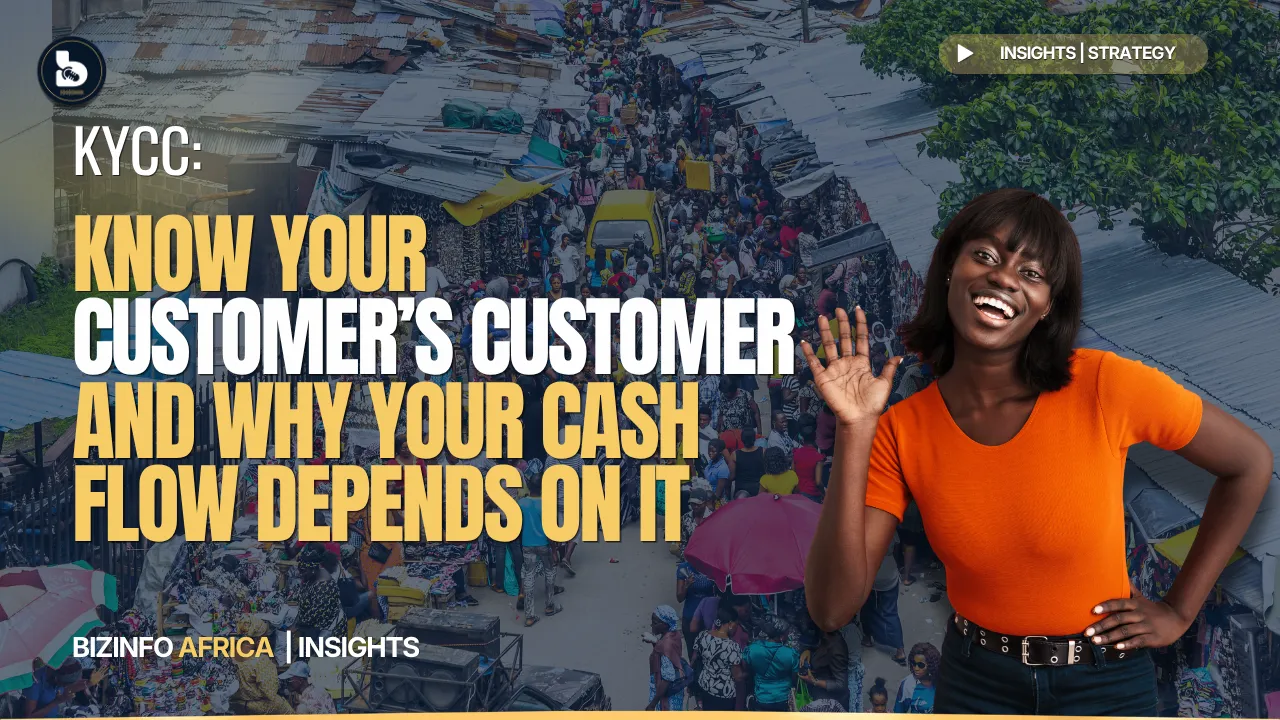
Know your customer's customer (KYCC) means checking who pays your customer. KYC confirms who your customer is. KYCC asks who pays them, how concentrated that base is and what terms sit upstream. A customer can pass every identity check and still pay you late, because your cash flow rests on a client base you can't see. This guide covers how to see it, the five questions to ask, and how funders already run the same check on you.
60+ days
is what our 30 day terms became on one subcontract, with a main contractor that passed every check.
Sh465.87bn
in national government pending bills at March 31, 2026.1
Sh156.84bn
more owed by county governments on the same date.2
What is know your customer's customer, and how is it different from KYC?
KYC is about the company in front of you. Is it registered? Who owns it? Is it sanctioned? Are the directors who they say they are? Those are real checks and they matter. I cover them in how to verify a company in Kenya and beneficial ownership in Kenya.
KYCC adds the layer that decides whether you get paid. Who are their customers? How many? How reliable? What terms do those customers give them? The answers set how fast cash reaches you, and almost no onboarding process asks for them.
The idea of looking through a customer to its own customers comes from banking compliance. There it's a contested burden: the Financial Action Task Force's 2016 guidance on correspondent banking says its standards don't require a correspondent bank to run due diligence on each customer of the banks it serves.3 I'm using the term commercially. A bank asks it about money laundering. You should ask it about cash flow.
Why does your cash flow depend on someone else's customers?
Because every business is a pipe. Cash comes in from customers and goes out to staff, suppliers and tax. If your customer's inflow is erratic, its payment to you is erratic. You inherit its volatility.
Three things drive that:
- Concentration. A customer whose revenue rests on one or two clients is as safe as those clients are punctual.
- Quality of payers. A customer serving government or large corporates inherits their payment cycles. The national government's pending bills stood at Sh465.87 billion on March 31, 2026, and counties owed a further Sh156.84 billion.12 If your customer is waiting in that queue, so are you. I cover that queue in pending bills in Kenya.
- Position in the chain. The further down you sit, the longer you wait.
KYC tells you who your customer is. KYCC tells you whether you'll get paid.
What does a KYCC failure look like in practice?
From the desk (anonymised)
We took on a subcontract. We'd been brought in for our experience, and we delivered premium work. Then came the chase, and every follow-up ended the same way: "the end client hasn't paid".
The main contractor's terms with the end client hadn't been disclosed to us. Our 30 days was really 60 or more, before the normal delays.
What matters is what the checks showed. Nothing about the main contractor failed KYC. Its registration, directors and standing were fine. We hadn't asked the KYCC questions, and the chain was longer than the contract showed. The fuller version of this story is in our credit-check guide.
Notice what didn't go wrong. Nobody lied about who they were. Nobody was insolvent. The contractor was simply passing its own customer's lateness down the line, and we were the last link. That's the pattern KYC can't catch.
How do funders already run KYCC?
This isn't a theory I made up for small businesses. It's how the people who price risk for a living already work. Most of my own experience with KYCC is on the funder side.
- Trade credit insurers. Before an insurer assigns a premium, it analyses the debtor portfolio: who owes the business money. Concentration is a big factor in that underwriting. A book that leans on one or two buyers gets underwritten as one or two bets.
- Banks. Most of the financing requests banks see from smaller businesses sit on invoices to corporates. Corporates are notoriously slow at paying small suppliers. So the bank looks hard at the corporate, because that's who will repay the facility.
If the people lending money check your customers before they price you, you should check your customer's customers before you extend credit. Giving 30 days is lending. I go deeper on the funder's side in invoice discounting in Kenya.
How do you do KYCC before you sign?
- Ask who their top customers are. Directly, in onboarding. If the answer is one or two, price that in.
- Ask for the upstream payment terms. For subcontracts, request the end client's terms with the main contractor in writing.
- Tie your payment to a date, not to their receipt. A clause that says "payable 30 days from invoice" beats "payable after the end client pays". Pay-when-paid language moves the end client's risk onto you.
- Take trade references. From their other suppliers, not only the ones they hand you.
- Check trading status and payment behaviour. A verified report confirms the business is operating and how it treats its suppliers.
- Cap exposure. Set a limit per customer and a trigger to stop work.
None of this needs a compliance department. It needs one email before the contract and one paragraph in it.
What are the five KYCC questions?
- Who are your three largest customers, and what share of revenue is each?
- What are your payment terms with them, and how often do they pay on time?
- For this project, who is the end client and what are their terms with you?
- Is our payment tied to a date, or to your receipt of payment?
- Has any customer ever paid more than 60 days late, and what happened?
Ask them politely, early and in writing. Keep the answers with the contract. A customer who answers openly is telling you something. A customer who dodges is telling you more.
What do you do when a customer won't answer?
You don't have to walk away. You change the terms so that you're no longer the one carrying the risk.
- Take a deposit or bill by milestone so that you aren't funding the whole job.
- Shorten the terms for the first few invoices, and lengthen them once they've paid on time.
- Lower the cap. Decide the most you're prepared to be owed, and stop work when you reach it.
- Price the wait. Late money has a cost. The Cost of Waiting calculator shows what long terms cost you.
A refusal to say who pays them isn't proof of a problem. Some customers are bound by confidentiality. But it's information, and it should move your terms.
Where does KYCC matter most?
In three situations. First, subcontracts, where you're paid after the main contractor is paid and the end client's terms are hidden from you. Second, customers who serve government, where payment cycles follow budgets and releases, not invoices. Third, any single customer that makes up a large share of your revenue, or of theirs. In each case the risk sits one step beyond the entity you can see.
How concentrated is your own client base?
Run KYCC on yourself. A bank, a corporate buyer or an investor will. Start with one number: the share of last year's revenue that came from your largest customer. Then do the same for your top three.
The bands are mine, and they're a rule of thumb. For comparison, one US factoring company says it generally prefers to keep any single debtor under 20 percent of the book it funds.4 That's one provider's view, but it shows where a funder starts to pay attention.
Concentration isn't always a mistake. Many good businesses start with one anchor client. It becomes a mistake when you can't survive their late payment and you haven't priced that in.
What do you do about customer concentration?
You don't have to fire your biggest customer. You have to stop being unable to survive without them.
- Measure it. Top one and top three, every quarter.
- Extend the contract. A longer term with firm payment dates is worth more than a higher price on open-ended work.
- Build a deposit or milestone structure so that you're not funding the work.
- Add a second and third anchor. Each new customer reduces the weight of the first.
- Hold a cash buffer sized to the longest delay you've seen from your largest payer.
How do lenders and corporate buyers do KYCC on you?
They ask the same questions in different words. A bank credit officer reading your application wants to know who your customers are, how concentrated your revenue is, how long they take to pay and whether the contracts are written. A corporate buyer wants to know whether you can survive a delayed payment on its own invoice.
If most of your revenue comes from one customer, say so first and show the mitigation: contract length, deposit terms, a pipeline to dilute it. If you can answer without hesitating, you look like a safer business than a competitor who can't.
The Business Confidence Index is a 60-question assessment of how lenders, buyers or investors would read your business, with a readiness band and three main gaps. Customer dependence is the sort of thing it surfaces.
Why does almost nobody ask the KYCC question?
Because KYC is a compliance task and KYCC is a commercial one. Compliance has a checklist and a regulator. Cash flow has an owner who is busy delivering the work. The question "who pays you?" feels awkward in the middle of a friendly negotiation, so it gets skipped.
It costs one email to ask. Not asking can cost you months of payroll.
Check how much cushion you really have
The Financial Health Check turns your balance sheet and P&L figures into financial ratios and a health score out of 100. Run it before you accept terms that depend on one customer's cash.
Frequently asked questions
What is KYCC?
Know Your Customer's Customer. It means checking who your customer is and also who pays them and how reliably, because your cash flow depends on that chain.
How is KYCC different from KYC?
KYC confirms identity, ownership and standing of the company in front of you. KYCC looks one step further, at that company's own customers, their concentration and the payment terms upstream. KYC tells you who they are. KYCC tells you whether you'll get paid.
Why does KYC pass and the deal still go bad?
KYC doesn't measure whether your customer's own customers pay it. A legitimate, well-run company can still pay you late if its client base is concentrated or slow-paying.
What is customer concentration?
The share of a business's revenue that comes from a small number of customers. A business that relies on one or two clients is exposed if either pays late or leaves.
How do I find out who my customer's customers are?
Ask directly during onboarding, request the upstream payment terms in writing for subcontracts, take trade references from their other suppliers and use a verified report that reviews trading status and payment behaviour.
What is a pay-when-paid clause?
A term that makes your payment depend on your customer first being paid by its own client. It moves the end client's payment risk onto you. A clause tied to a date from your invoice is safer. Have a lawyer review the wording.
Do banks and insurers really look at my customers?
In my experience, yes. Trade credit insurers analyse a debtor book before setting a premium, and concentration is a big factor. Banks financing invoices look closely at the corporates that owe you.
I use KYCC as a commercial idea, not a regulatory requirement. The funder section reflects my experience and isn't a published standard. The concentration bands are a rule of thumb. The pending bills figures are news reports of Controller of Budget data, and the 20 percent figure is one factoring company's own material. Have a lawyer review contract wording. General information, not legal or financial advice.
Sources
- The Star: Suppliers wait as Nyakang'o warns Sh466bn pending bills hurting economy (June 17, 2026)
- The Star: First-term governors abandoning pending bills from predecessors (June 25, 2026)
- Financial Stability Board: FATF Guidance on Correspondent Banking Services (October 2016)
- Viva Capital: How debtor credit affects your ability to factor invoices (a factor's own material)
General information only. Not financial, tax or legal advice. Figures are as reported by the cited sources on the publication date; verify before acting.