
Short answer
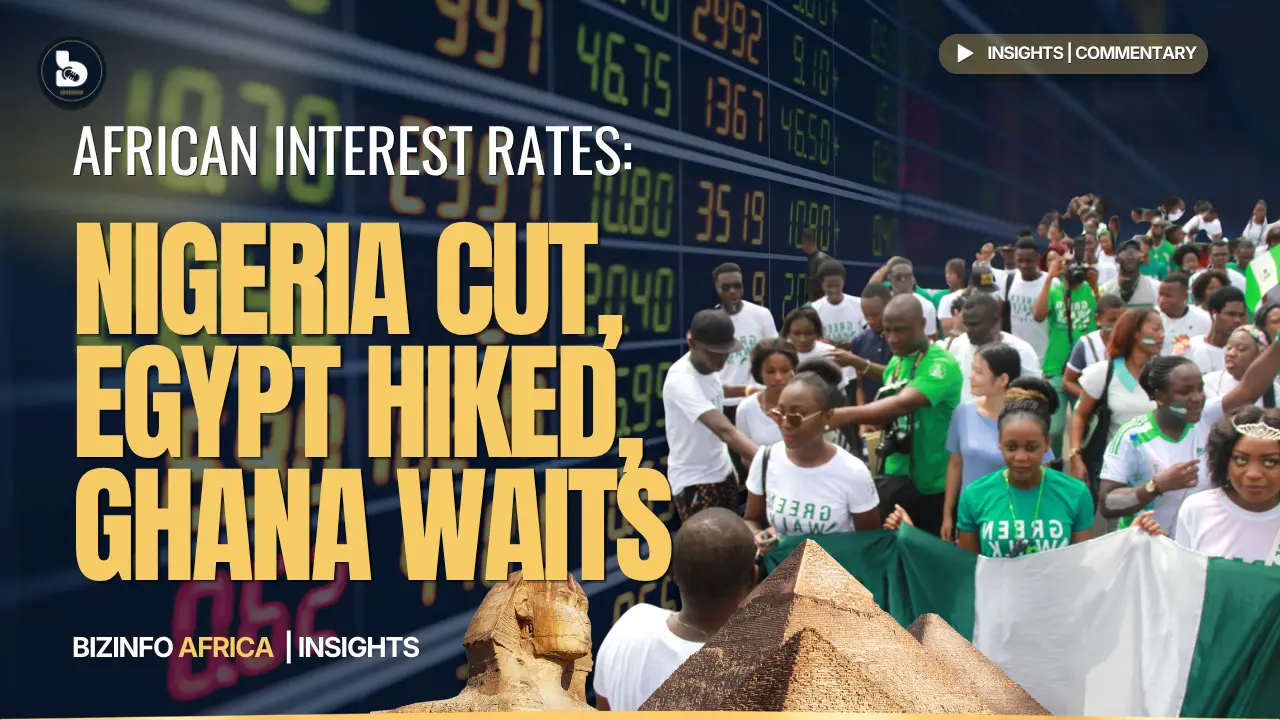
African interest rates are moving in three directions. Nigeria cut its policy rate by 350 basis points to 23% in September. Ghana has held at 14% since March. Egypt raised its key rate by 100 basis points to 20% on October 29. Three central banks, three directions. Subtract the latest inflation and the rough real rates come out near 8.4 points in Nigeria, 8.5 in Ghana and 6.1 in Egypt. The currency and the fiscal gap decide how much of that you keep.
23%
Nigeria MPR. Cut 350 bps on September 22.
14%
Ghana policy rate. Unchanged since March.
20%
Egypt key rate. Raised 100 bps on October 29.
What did Nigeria, Ghana and Egypt's central banks just do?
Nigeria first. The CBN's Monetary Policy Committee cut the benchmark rate from 26.50% to 23.00% at its September 22 meeting, the biggest single cut since December 2006.1 Headline inflation was 14.63% in September, down from 15.39% in August and 20.98% a year earlier.2
Ghana went the other way on momentum, not on the rate. The Bank of Ghana has kept its policy rate at 14% since March. October inflation rose to 5.5%, an 11-month high, up from 5.2% in September.3
Egypt surprised people. The Central Bank of Egypt raised its key rate by 100 basis points to 20%, the first hike since March 2024, when analysts had expected no change. Urban inflation was 13.9% in September, still well above the bank's 7% plus or minus 2 point target range.4 The CBE had already warned that inflation would pick up in the third quarter on base effects and supply shocks tied to regional conflict.5
Are real African interest rates in these three markets actually high?
On paper, yes. Policy rate minus the latest inflation print is the quick version of a real rate. It's rough, and the inflation months aren't identical across the three countries. But it makes the point.
Look at Ghana. Inflation of 5.5% sits below the 6% to 10% band the Bank of Ghana targets, so the real rate is wide even with a rate that has been frozen for months.3 Egypt has the narrowest gap and is the only one of the three tightening. That fits: its inflation is the furthest above target.
A wide real rate tells you what the central bank is charging. It doesn't tell you what you'll receive in dollars.
Why does the currency matter more than the headline rate?
Because a high yield in a weakening currency is a smaller yield. Ghana's cedi has lost about 10% against the dollar this year, and the same report links the weaker cedi to higher prices.3
Nigeria's pressure point is fiscal. A study in the CBN's own Journal of Applied Statistics found that budget deficits were a primary driver of exchange-rate depreciation, and it found no statistically significant direct link between deficits and inflation.6 The federal government raised its 2026 borrowing plan to N29.20 trillion in April.6 On November 4 it asked the Senate to approve N10.79 trillion in external borrowing.7 Foreign reserves added $295 million in October, the slowest monthly gain of 2026.8
None of that says the naira will fall. It says the rate cut and the borrowing plan are pulling in different directions, and that's the thing to watch.
What should investors and treasurers watch next?
- November 18: Bank of Ghana decision, with inflation now at an 11-month high.3
- November 23 and 24: Nigeria's next MPC meeting.9
- December 17: the last scheduled Egyptian MPC meeting of the year.10
Three questions are worth asking before you call any of these yields real. Is inflation falling or rising? Is the currency holding? Is the government borrowing more than the rate path can absorb? Nigeria answers yes, yes-ish and not clearly. Ghana answers rising, weaker and fine. Egypt answers falling but too high, so tight. Each one needs its own check.
Compare the markets side by side
The Africa Intelligence Map covers all 54 countries: capital, currency, regional blocs, AfCFTA ratification status and World Bank figures on GDP, growth and inflation, each with the year it was reported.
Frequently asked questions
What is Nigeria's interest rate now?
The Central Bank of Nigeria's Monetary Policy Rate is 23.00% after a 350 basis point cut on September 22, 2026. The next MPC meeting is scheduled for November 23 and 24.
Did Egypt raise interest rates in October 2026?
Yes. The Central Bank of Egypt raised its key rate by 100 basis points to 20% on October 29, 2026. It was the first increase since March 2024.
What is Ghana's policy rate?
The Bank of Ghana's policy rate is 14%, unchanged since March 2026. Its next decision is on November 18.
What is a real interest rate?
A real interest rate is the interest rate minus inflation. This article uses the simple version: the policy rate minus the latest headline inflation figure.
Sources
- Nairametrics: Top 10 African countries with the highest interest rates in September 2026
- Gazette NGR: Nigeria's inflation dropped to 14.63% in September, NBS
- Nairametrics: Ghana inflation rises to 5.5%, highest in 11 months
- Trading Economics: Central Bank of Egypt delivers surprise rate hike
- Daily News Egypt: CBE expects inflation to accelerate through Q3 2026
- Nairametrics: Nigeria's budget deficits fueling naira depreciation, CBN study finds
- Nairametrics: Tinubu seeks Senate approval for N10.79 trillion external borrowing
- Nairametrics: Nigeria's foreign reserves add $295 million in October
- African Exponent: Top 10 central bank interest rates in Africa in 2026
- Enterprise: Urban inflation unexpectedly slowed to 14.5% in August
General information only. Not financial, tax or legal advice. Figures are as reported by the cited sources on the publication date; verify before acting.