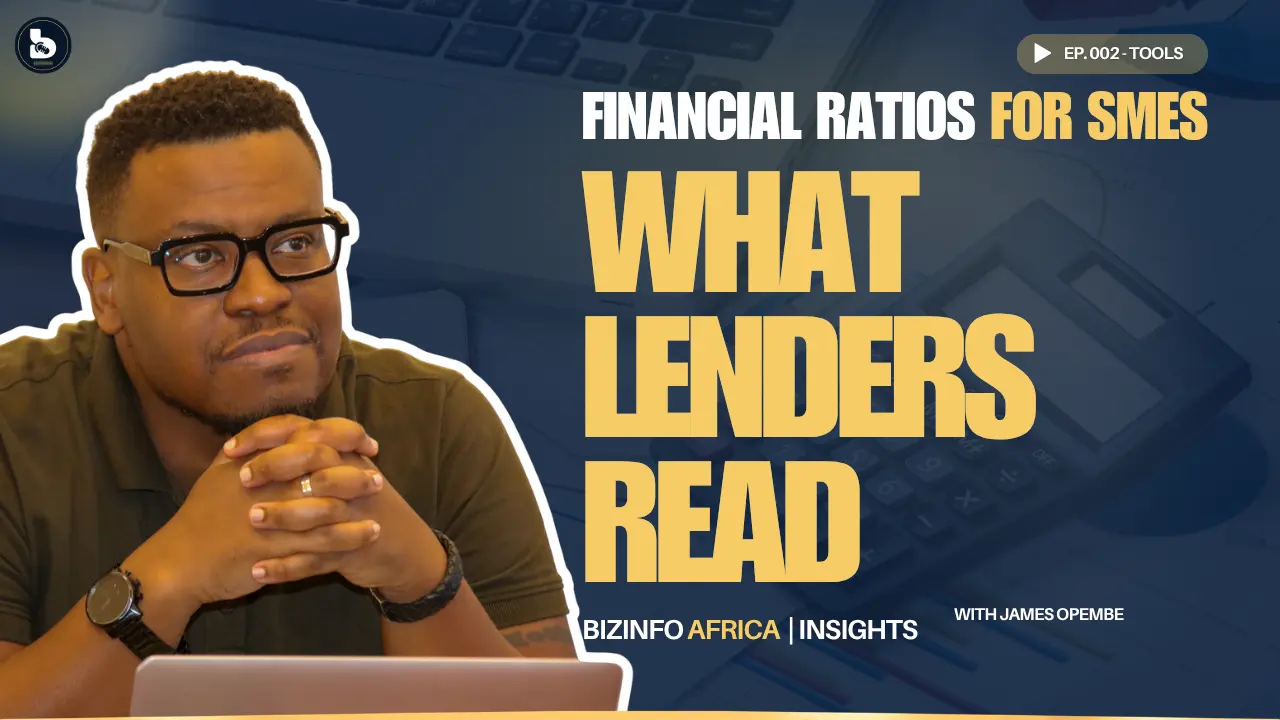
Two businesses can report the same revenue and carry very different risk. A lender reads the pattern in your numbers before it reads your story.
Lenders and other counterparties can derive liquidity, leverage, working-capital pressure and operating efficiency from basic financial statements. Two SMEs with similar revenue can therefore present very different financial profiles. The Financial Health Check is a diagnostic scorecard, not a lender’s credit decision or a substitute for verified financial evidence.
Profit is one line in a wider picture. From a balance sheet and P&L, a counterparty can work out whether you can cover short-term bills (liquidity), how much you lean on debt (leverage), what your margins really are, and how efficiently you turn stock, receivables and assets into cash. That's why two SMEs with similar sales can look nothing alike to a lender. The Financial Health Check takes 12 core inputs, calculates ten standard ratios and gives a score out of 100, so you can see your business the way an analyst might.
What the score can and can't tell you
Treat the result as a worklist, not a verdict. The useful output is the weak area, because it shows what to fix and document before someone else asks. The tool also shows an Altman-style comparison for reference, but Altman's published work, including his 1968 bankruptcy paper,[3] rests on defined samples and model assumptions. It isn't a Kenya scorecard, and the Financial Health Check isn't a lender's credit decision.
What a self-assessment can't reach is accuracy. It can't tell whether the statements are right, whether every liability is on the books, whether tax or litigation exposures exist, or whether a customer will pay on time. A lender or large buyer checks those from outside evidence, which is the due diligence step. Market-wide sources such as the World Bank Enterprise Surveys for Kenya[4] give context on the business environment, but they can't tell you what a particular lender will approve for you.
So run the check with your latest statements, pick the weakest ratio, fix the cause, document the change and run it again. A stronger score is still self-reported until someone reviews the evidence. When another party needs to rely on your numbers, a verified evaluation replaces "trust us" with proof.
Use the score as a diagnostic. Use evidence when another party needs to rely on the result.
Request your verified reportExplore the toolsCommon questions
What financial ratios do lenders look at for SMEs?
Commonly reviewed ratios include liquidity, leverage, profitability and efficiency measures. The exact mix varies by lender, product and sector.
How do you assess the financial health of a small business?
Start with the balance sheet and P&L, calculate relevant ratios, compare current performance with prior periods where available, and investigate the weakest indicators.
Why can two businesses with the same revenue have different risk?
They can have different debt, cash, receivables, payables, margins and asset structures. Revenue alone does not describe liquidity or leverage.
What does a liquidity ratio tell a lender?
It indicates how readily current obligations may be covered by current assets or near-cash resources, depending on the ratio used.
Is the Financial Health Check a credit score?
No. It is a first-party financial diagnostic scorecard based on the inputs provided. It is not a lender’s credit score or underwriting decision.
Sources
- Primary platform BizInfo Africa, Financial Health Check page and methodology
- Research Altman, emerging-market scoring work cited by the tool
- Research Altman, 1968 ratio-based bankruptcy prediction paper, Journal of Finance
- Primary data World Bank Enterprise Surveys, Kenya
- Official guidance Central Bank of Kenya, bank supervision resources
Sources and figures checked 2 October 2026. Verification services by ASAP Information Services Ltd.